
Roof cleaning is one of those property maintenance tasks most owners think about only when the roof is clearly overdue. By then, biological growth has usually been established for years, and the cost of recovery is significantly higher than the cost of regular cleaning. This guide covers how often roofs should actually be cleaned in Australia, with specific guidance for the NSW coastal and inland regions SOAKD services.
The General Rule for Australian Properties
For the majority of Australian properties, a professional softwash roof clean every 2 to 3 years is the right baseline. That range assumes a standard suburban property with normal environmental exposure, a reasonable amount of tree cover, and a roof material in good structural condition.
Three factors push the interval shorter or longer:
- Climate exposure. Humidity, salt air, and rainfall patterns directly affect how quickly biological growth establishes on your roof.
- Tree canopy and shading. Shaded roofs stay damp longer and collect organic debris. A roof under heavy canopy often needs cleaning twice as often as an exposed roof on the same street.
- Roof material. Porous materials like concrete and terracotta tiles support growth more readily than metal or glazed surfaces.
A roof that shows visible dark streaks, green patches, or moss clumps is already past the ideal cleaning point. The goal is to clean before growth becomes visible, not after.
Cleaning Frequency by NSW Region
SOAKD services coastal and inland NSW, and the cleaning schedule varies significantly between these environments.
Coastal Central Coast, Newcastle, and Lake Macquarie: 12 to 18 months
Properties in suburbs like Avoca Beach, Terrigal, Merewether, Bar Beach, Swansea, and Warners Bay are exposed to three compounding factors: salt-laden air that feeds algae and lichen, high ambient humidity, and shorter surface drying cycles after rainfall. This combination dramatically accelerates biological growth.
Coastal properties that go longer than 18 months between cleans typically reach the point where growth has penetrated tile pores and started to cause physical surface damage. Annual cleaning is the safest interval for properties within 1 km of the coast. Properties 1 to 5 km inland can generally stretch to 18 months.
Sydney Metro and Inner Suburbs: 2 to 3 years
Inner Sydney suburbs such as Parramatta, Chatswood, Baulkham Hills, and the Sutherland Shire sit in a moderate exposure zone. Air pollution, seasonal rainfall, and tree cover are the main drivers rather than salt exposure. A 24 to 36 month cleaning interval is appropriate for most of these properties.
The exception is the Eastern Suburbs (Bondi, Coogee, Bronte, Maroubra) which sit in the coastal exposure zone and should follow the 12 to 18 month schedule.
Hunter Valley and Rural Inland: 3 to 5 years
Inland properties in the Hunter Valley, including Muswellbrook, Cessnock, Maitland, and Singleton, experience lower humidity and less salt exposure. Biological growth develops more slowly, and a 3 to 5 year cleaning cycle is often sufficient for properties in open settings.
Rural properties near dams, creeks, or dense bushland can need cleaning more frequently because of localised humidity. Any property near water or under heavy canopy should follow the coastal schedule regardless of geographic region.
Cleaning Frequency by Roof Material
Concrete Tiles
Concrete tiles are the most common residential roof material in NSW and the most susceptible to biological growth. Their porous surface holds moisture, and the textured finish gives lichen and moss ideal purchase. Concrete tile roofs should be cleaned every 2 to 3 years, reducing to every 12 to 18 months in coastal environments.
Terracotta Tiles
Terracotta tiles have a glazed surface that is slightly less hospitable than concrete, but the grout lines and overlap points still support growth. Terracotta roofs follow a similar schedule to concrete: 2 to 3 years inland, 12 to 18 months coastal. Older terracotta where the glaze has weathered behaves more like concrete and needs the shorter interval.
Colorbond and Steel Roofs
Metal roofs resist moss and lichen far better than tiles, but they are not maintenance-free. Salt deposits, airborne dust, pollen, and tree sap accumulate on the surface and affect both appearance and the protective coating’s long-term performance. Colorbond roofs on coastal properties should be rinsed every 12 to 18 months and softwashed every 2 to 3 years. Inland Colorbond can often stretch to 3 to 5 years between cleans.
Slate and Natural Stone
Slate is durable but porous. The lichen that commonly establishes on slate roofs in shaded positions can be particularly difficult to remove if left for long periods. A 3 year cleaning interval is appropriate for most slate roofs in good condition.
Signs Your Roof Is Overdue
Waiting for visible damage is not a cleaning strategy. That said, once these signs appear, the roof should be cleaned as soon as practical:
- Dark streaks or staining, particularly running down the slope from areas of shade. This is almost always gloeocapsa magma, a photosynthetic bacteria that feeds on the limestone filler in tiles.
- Green patches or fuzzy growth. This is algae or moss in early stages.
- Raised clumps or pillows. This is established moss. The root system is already embedded in the tile surface.
- White or grey crusty patches. This is lichen, which releases acids that etch the tile surface. Lichen is the most destructive of the common roof growths.
- Gutters full of organic debris and tile granules. Granule loss from degraded tiles is a sign the surface coating has been compromised.
The Cost of Delay
Regular cleaning on a 2 to 3 year schedule costs significantly less over the life of a roof than letting growth establish and then treating it years later. Three reasons:
- Labour time increases. Entrenched growth requires longer dwell times, sometimes a second application, and additional rinsing.
- Surface damage may require repair. Cracked tiles, lost granules, and damaged flashings identified during cleaning still need replacing before the roof is fully serviceable.
- Roof lifespan shortens. A well-maintained concrete tile roof can last 40 to 50 years. A neglected roof with sustained biological growth typically needs replacement at 25 to 30 years. The cost difference is measured in tens of thousands of dollars.
The cheapest roof is the one cleaned on schedule.
When Softwash Is the Right Method
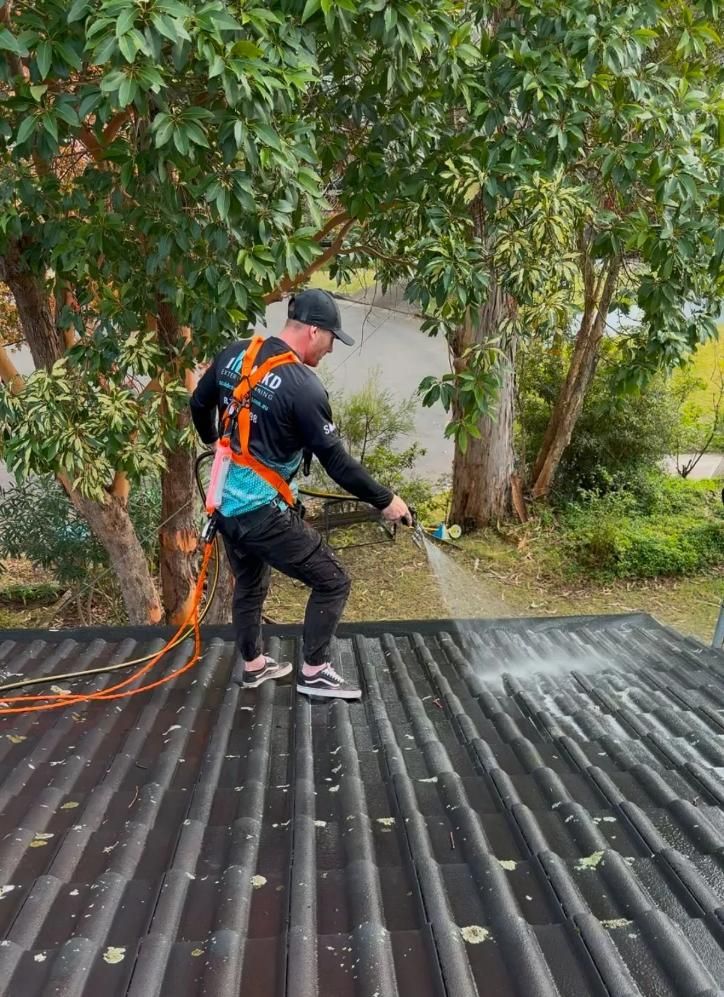
Roof cleaning in Australia should almost always be done with softwash, not high-pressure water. Softwash uses low-pressure application of biodegradable cleaning solutions to kill growth at the cellular level, with results that last 12 to 24 months. High-pressure washing strips protective coatings, forces water under overlaps, cracks aged tiles, and removes growth only at the surface, meaning regrowth starts within weeks.
For a detailed comparison, see our guide to softwash vs pressure washing. For the broader context on why coastal NSW properties need more frequent attention, see salt air damage on Central Coast and Newcastle buildings.
Quick Reference Schedule
| Environment | Frequency | Notes |
|---|---|---|
| Coastal (within 1 km of coast) | Every 12 months | Salt air accelerates growth; annual cleaning prevents surface damage |
| Coastal fringe (1 to 5 km inland) | Every 12 to 18 months | Still exposed to humidity and salt influence |
| Sydney metro / suburban | Every 2 to 3 years | Moderate exposure; visible staining is the trigger |
| Inland rural (Hunter Valley) | Every 3 to 5 years | Lower humidity extends interval |
| Heavy tree canopy | Halve the above | Shade holds moisture and accelerates growth |
Book a Professional Assessment
SOAKD services Sydney, the Central Coast, Newcastle, Lake Macquarie, and the Hunter Valley. If you are not sure when your roof was last cleaned, or you can see visible growth starting to establish, call 0418 167 798 or request a free assessment online. We will photograph the roof, identify the growth type, and give you an honest recommendation on whether the roof needs cleaning now or can safely wait another 6 to 12 months.